










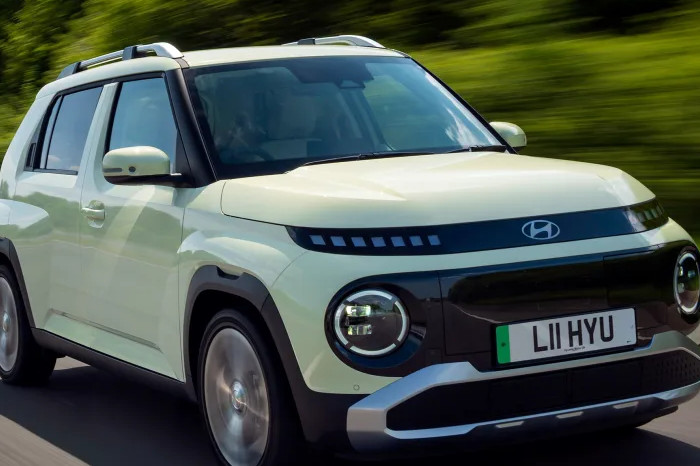
The Hyundai Inster is Hyundai’s newest and most compact electric vehicle — a car that perfectly blends quirky design with serious urban practicality. Its boxy silhouette may look playful, but inside lies a surprisingly roomy and efficient city EV that proves good things really do come in small packages. Built to rival models like the Renault 5, Citroën e-C3, and Fiat Grande Panda, the Inster redefines what an entry-level electric car can be.
This pint-sized EV shares its spirit with the South Korean Hyundai Casper, yet it has been re-engineered for global markets with more advanced technology and a more refined electric setup. It feels instantly likable, with a blend of cuteness and competence that makes it stand out in a crowd of serious-looking electric hatchbacks.
Performance and Powertrain
The Inster is available with two battery choices: a 42kWh Standard Range pack and a 49kWh Long Range version. Both power the front wheels via a single electric motor, producing either 96bhp or 113bhp depending on the variant. The stronger motor cuts 0–62 mph down to 10.6 seconds and reaches a top speed of 93 mph, giving the little Hyundai enough energy for city commutes and highway bursts alike.
While the acceleration isn’t blistering, it feels eager and agile around town. The instant torque delivery lets the Inster leap forward smoothly, making it ideal for stop-and-go traffic. On open roads, performance remains composed, with predictable handling and reassuring grip. The steering is light yet precise, offering a balance of comfort and control rarely found in small EVs.
Driving Experience
In urban environments, the Inster feels perfectly at home. Its narrow body and tight 10.6-metre turning circle make navigating narrow streets and parking in tight spaces a breeze. The regenerative braking system, adjustable via steering wheel paddles, enables one-pedal driving, adding convenience during daily commutes.
Ride quality is impressive for such a short-wheelbase car, though potholes can occasionally send jolts through the cabin. On the motorway, the Inster maintains stability, but road and wind noise become noticeable at higher speeds a reminder that refinement still leans toward city use. Even so, efficiency remains a strong suit, with real-world results of around 4 miles per kWh, giving a range close to 196 miles on mixed routes.
Charging and Efficiency
Charging the Hyundai Inster is simple. On a standard 7.4kW wallbox, a full charge takes about 6–7.5 hours, depending on the battery. Fast charging at up to 85kW (73kW for the smaller pack) brings the battery from 10 to 80 percent in around 30 minutes. These figures make it practical for both home charging and quick top-ups at public stations.
Official range estimates are 203 miles for the Standard Range and 229 miles for the Long Range model. In real-world conditions, the Inster’s efficiency easily compensates for its modest battery size, often outperforming larger rivals in energy use. Hyundai’s experience in electric technology proven in the Ioniq 5 and Kona Electric shines through here.
Design and Exterior
The Inster’s exterior is a delightful mix of retro and futuristic cues. The boxy stance, bulging wheel arches, and pixel-style lighting echo Hyundai’s EV design language seen on models like the Ioniq 5. The short overhangs, large circular lamps, and upright profile lend it an almost cartoon-like charm. Available in vibrant colors like Sienna Orange and Buttercream Yellow, it’s a car that doesn’t take itself too seriously — yet still turns heads.
Despite its compact footprint (3,845 mm long and 1,610 mm wide), the Inster’s presence is confident and friendly. Higher trims come with 17-inch diamond-cut alloy wheels, while base models wear 15-inch rims that complement the city-focused setup.
Interior and Comfort
Step inside, and the Inster surprises again. The cabin feels far roomier than its size suggests, offering ample head and legroom for four adults. The tall roofline, wide windows, and flat dashboard enhance visibility and space. Hyundai’s clever use of a sliding and reclining rear bench (available on higher trims) allows flexible cargo or passenger arrangements.
The dashboard layout is clean and intuitive, with physical controls for climate settings a welcome feature in an age of screen-heavy interiors. Dual 10.25-inch displays provide crisp graphics and easy smartphone integration via Apple CarPlay and Android Auto. While the materials are mostly hard plastics, the build quality feels solid, with no squeaks or rattles during driving.
For added style, customers can opt for a beige-and-houndstooth interior, giving the cabin a brighter and more premium vibe. Storage spaces are practical if modest, including cup holders, a smartphone tray, and a compact glovebox.
Practicality and Space
Despite being a small EV, the Inster makes excellent use of its compact dimensions. There’s generous space for both front and rear occupants, and the boot offers 238 liters of cargo capacity — expandable to 351 liters when the back seats slide forward. Folding the rear bench expands total volume to 1,059 liters, rivaling larger hatchbacks.
Passengers over six feet tall will still find plenty of headroom, while the wide-opening doors and upright seats make access easy. Hyundai clearly prioritized usability over flashiness, ensuring the Inster works as a genuine everyday car, not just a stylish urban toy.
Safety and Equipment
The Hyundai Inster earned a four-star Euro NCAP safety rating, on par with competitors in its class. Standard safety tech includes seven airbags, lane-keeping assist, driver attention monitoring, and forward collision avoidance. The top-spec Inster Cross adds blind-spot monitoring and advanced camera visibility features for improved awareness in tight traffic.
Every model also comes with Hyundai’s five-year unlimited mileage warranty, giving buyers peace of mind for long-term ownership. Insurance groups start at 21, and EV road tax applies after the first year at £195 annually.
Verdict
The Hyundai Inster may be small, but it delivers big on character, usability, and electric efficiency. It’s not the quietest or most luxurious compact EV, yet its personality, smart design, and real-world economy make it stand out in an increasingly crowded segment. For urban drivers seeking an affordable, cheerful, and cleverly designed electric car, the Inster offers one of the most well-rounded packages in its class.
With prices starting around £23,500, Hyundai’s newest EV proves that electrification doesn’t have to be expensive or dull — just smartly engineered and full of personality.