











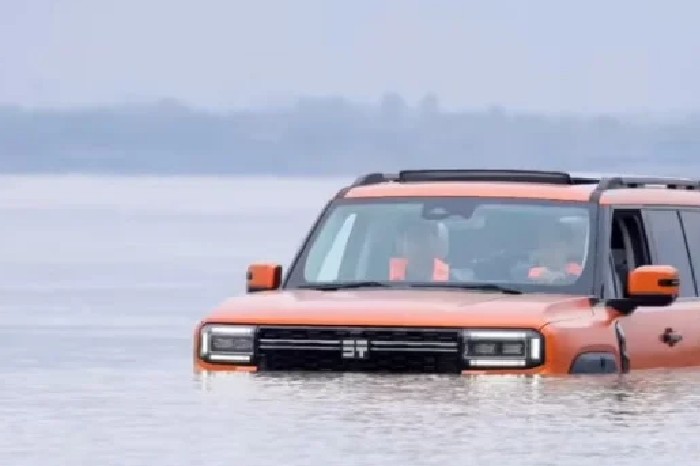
In a remarkable display of engineering prowess, Chery Automobile has achieved a historic milestone as its luxury SUV, the Jetour Zongheng G700, successfully crossed the Yangtze River, Asia’s longest river—becoming the first SUV in the world ever to do so.
The groundbreaking feat took place on October 16, 2025, beginning at Heisha Zhou Ferry Terminal in Wuhu, Anhui Province, home to Chery’s global headquarters, and concluding at Nanlong Ferry Terminal on the opposite bank.
Over a span of 22 minutes, the hybrid SUV traveled across 1,480 meters of water—covering approximately 1.2 kilometers—against river currents flowing between 5 to 10 km/h. The G700 maintained stable movement on the water’s surface at around 7 km/h, successfully completing the crossing.
This accomplishment highlights Chery’s cutting-edge engineering innovations, including a seamless body design, active air distribution system, and an 800V high-speed silicon carbide propulsion platform that ensures high efficiency and durability.
The vehicle is also equipped with a six-axis gyroscope that automatically balances the body to maintain optimal stability while navigating water surfaces. According to Chery’s Executive Vice President, the demonstration was not merely a test of endurance but a symbol of China’s growing strength in global automotive innovation.
The Jetour Zongheng G700 is set for an official launch on October 19, 2025. It will be introduced as a large luxury hybrid off-road SUV in four variants, priced between 349,900 and 429,900 yuan (approximately USD 48,000–59,000).
Under the hood, the model features a 2.0TD hybrid-dedicated engine producing 155 kW (208 hp) and 340 Nm of torque, with a thermal efficiency of 45.5%. It runs on an 800V architecture, includes a two-speed DHT transmission, dual-layer 4C battery pack, and a dual-speed P4 electric motor.
In total, the G700 delivers a combined output of 560 kW (751 hp) and 795 Nm of torque, offering an impressive driving range of up to 1,400 km on a full tank and charge.
The Yangtze River, also known as Chang Jiang in Mandarin, stretches about 6,300 kilometers, flowing from the Tanggula Mountains on the Tibetan Plateau to the East China Sea near Shanghai. The city of Wuhu, where the crossing took place, lies on the river’s southern bank, roughly 350 kilometers from its mouth.